INJECTION CLINICAL LIBRARY
INJECTION CLINICAL LIBRARY

Comparative Data
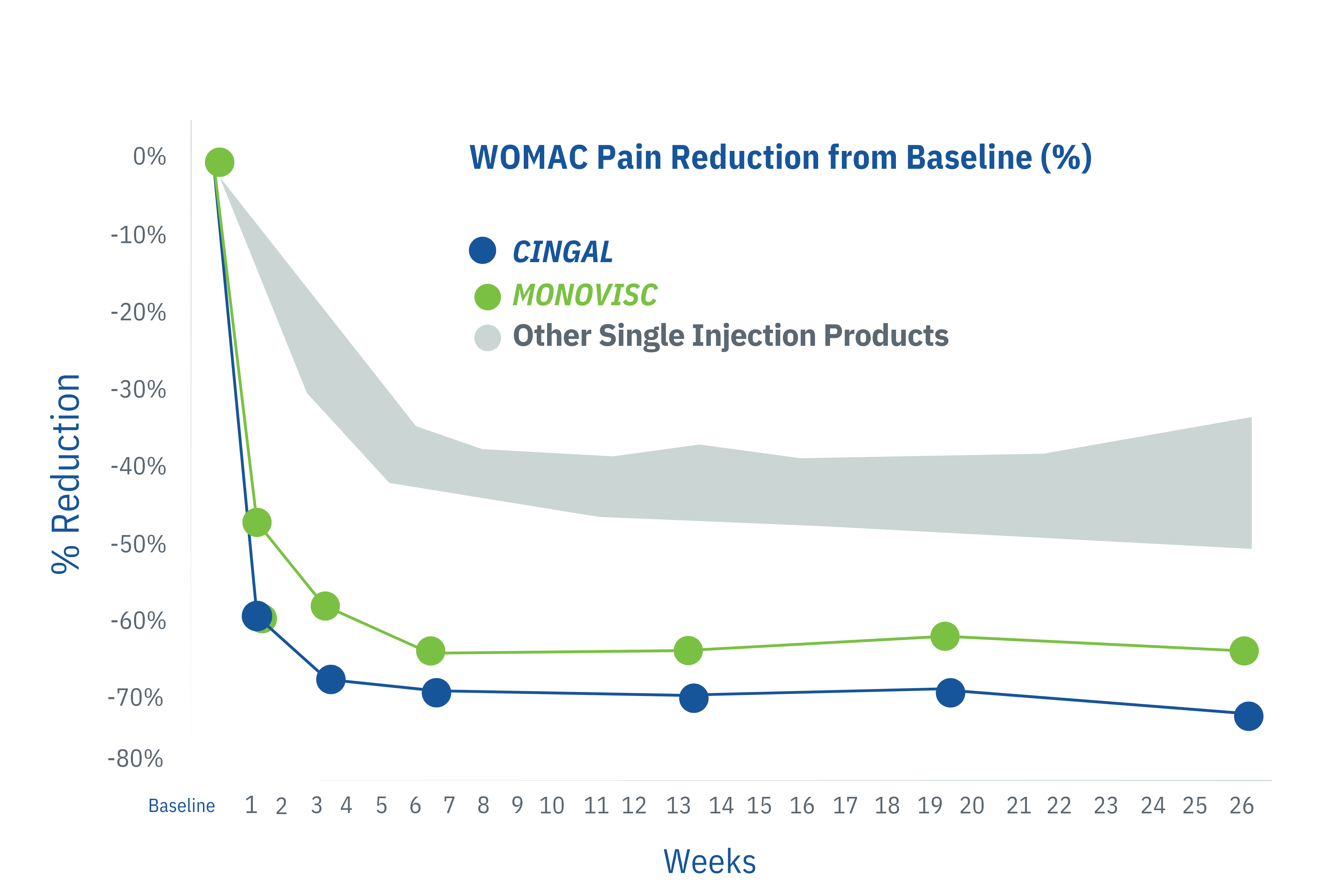
We compared all the data points from each leading HA injection to Cingal and Monovisc from the above study.
The data referenced from the competitor products is taken from their quoted trials on their marketing and websites.

Other key data points from this study are;
Key MONOVISC clinical data points
This data was taken from the same study as above, by Lazlo Hangody. A randomised, double-blind, Level 1 study.
Here you can see Monovisc (as plotted on the graph above) carries through a greater pain reduction to the 26 week mark than any other pure hyaluronic acid injection product.
Cingal as stated above achieved 72% reduction on pain at 26 weeks.


The synthesis of hyaluronic acid by human synovial fibroblasts is influenced by the nature of the hyaluronate in the extracellular environment.
Rheumatol Int. 1987; 7(3):113-22. Smith MM, Ghosh P.
Various cell lines of human synovial fibroblasts derived from synovium obtained at the time of biopsy or total joint-replacement surgery have been established. The synthesis of 3H-labelled hyaluronic acid (HA) in these cells has been determined, and the effects of adding HA of varying molecular size to the cultured cells examined. The results obtained clearly show that the in vitro synthesis of HA by these cells is influenced by the concentration and molecular weight (MW) of the HA in their extracellular environment. Synovial fibroblasts derived from an osteoarthritic joint demonstrated the most marked response on exposure to exogenous HA, showing a stimulation of HA synthesis with preparations of weight-average molecular weight (Mw) greater than 5 X 10(5) in a concentration dependent manner. HA preparations with Mw less than 5 X 10(5) showed little or no effect except at high concentrations where a suppression of biosynthesis was observed. A model to explain these findings is proposed.

Abstract:
Modern concepts of osteoarthritis (OA) have been forever changed by modern imaging phenotypes demonstrating complex and multi-tissue pathologies involving cartilage, subchondral bone and (increasingly recognized) inflammation of the synovium. The synovium may show significant changes, even before visible cartilage degeneration has occurred, with infiltration of mononuclear cells, thickening of the synovial lining layer and production of inflammatory cytokines. The combination of sensitive imaging modalities and tissue examination has confirmed a high prevalence of synovial inflammation in all stages of OA, with a number of studies demonstrating that synovitis is related to pain, poor function and may even be an independent driver of radiographic OA onset and structural progression. Treating key aspects of synovial inflammation therefore holds great promise for analgesia and also for structure modification. This article will review current knowledge on the prevalence of synovitis in OA and its role in symptoms and structural progression, and explore lessons learnt from targeting synovitis therapeutically.